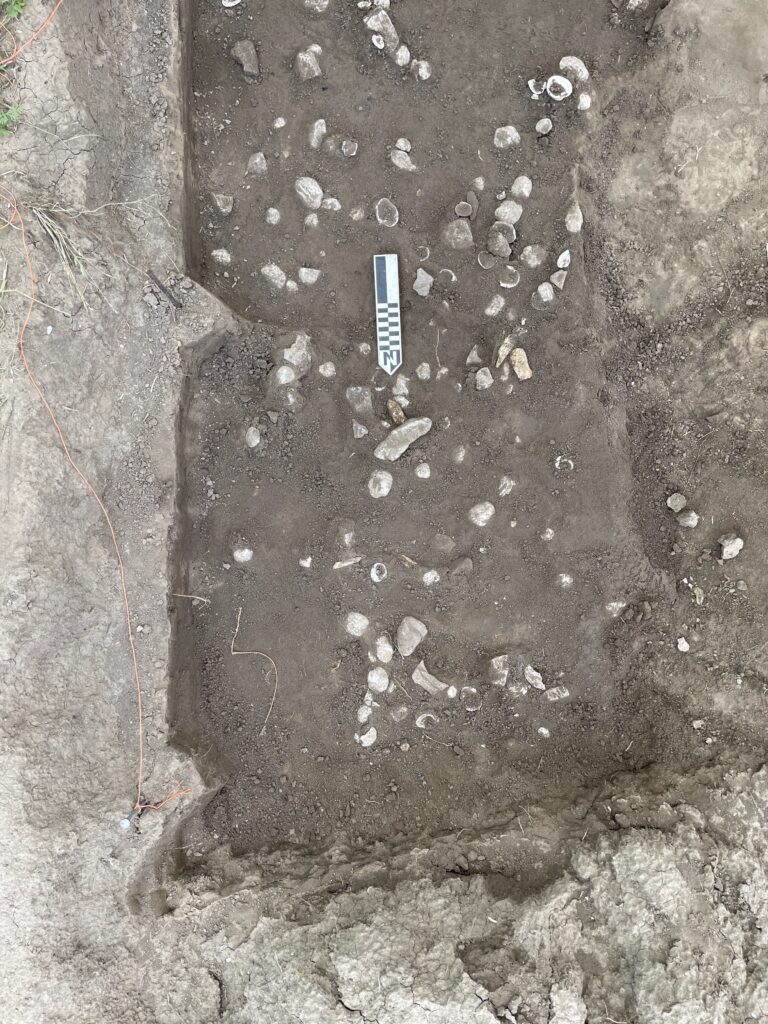
LUAS has returned to the San Saba River site to resume the excavations begun last summer. Previously, nearly all the site’s cultural deposits were removed during a pay-dig operation but a small area along the river was spared. This area lies right above an active cutback and will eventually erode into the river, so the LUAS excavation is basically a salvage operation. The excavation last summer encountered a buried living surface 50 cm below the surface dense with lithics and food remains probably dating sometime after AD 1500, based on the presence of ceramics. This summer we will excavate as much of this living surface as possible until we need to leave the property for good. Our other project, the Antelope Draw excavation in Lampasas County, has been suspended for the time being while we concentrate on this site.
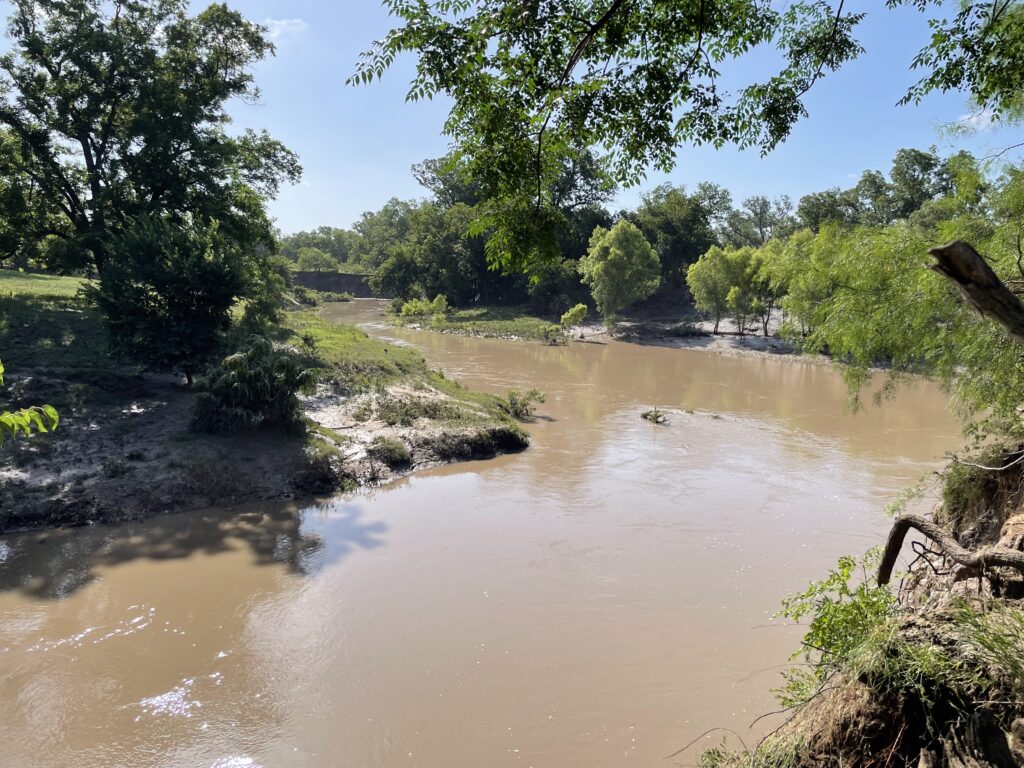
View of the San Saba River from site soon after a flood in June, 2025
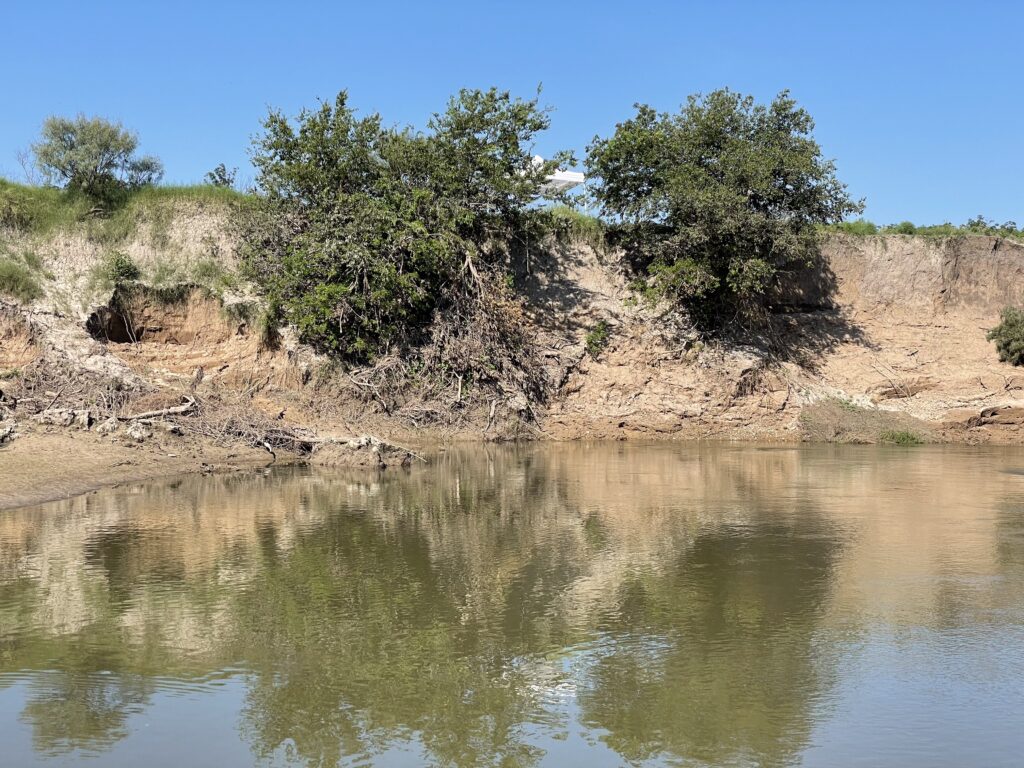
Excavation area (white canopy) above cutbank after devastating July floods.
While the LUAS excavation is a salvage excavation, we hope to address some issues raised by the pay-dig operation..
Are bone-tempered (“Leon Plain”) ceramics present at the site? Photos posted on the Internet by the pay-dig operation showed sherds belonging to Caddo pottery from East Texas and at least one (corrugated) sherd from a Southwestern vessel probably from New Mexico, but no definite sherds from the locally-made bone-tempered ware usually recovered from Toyah sites in the region. So far in the LUAS excavation, only Caddo sherds have been unearthed, all possibly belonging to one large jar with incised and appliqué decoration.
Is this the site of a large bison kill? The pay-dig operators thought this might be a bison kill site, based on the large number of bison bones they encountered, including at least one complete bison skull. During the LUAS excavations, only fragmentary bison bones have so far been recovered, most purposefully broken for marrow and grease extraction. Deer bones are also common as well as those from smaller mammals and turtles with a few bones from a large turkey-size bird and a catfish
Living surface with scattered mussel shells, animal bones (including bison), lithics, and a ceramic sherd
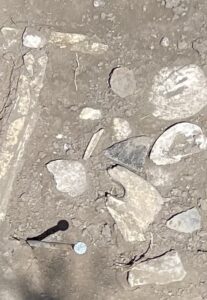
Rim Sherd from a Caddo ceramic vessel (Maydelle Incised, post-A.D. 1440) shown above a bison mandible fragment.
*UPDATE*
Fieldwork at the San Saba River site is now over. We had hoped to excavate more of the site but it was time to leave after two seasons. LUAS was able to excavate 40 square meters of the surviving part of the site above the river cut bank. While no intact cooking feature were identified, we did collect biologically young carbonized plant materials in good context for radiocarbon-dating. Considering the presence of contracting-stem “Perdiz” points and the apparent lack of bone-tempered ceramics, we expect the occupation to date to the middle part of the Toyah period, probably in the range of AD 1450 and 1550.
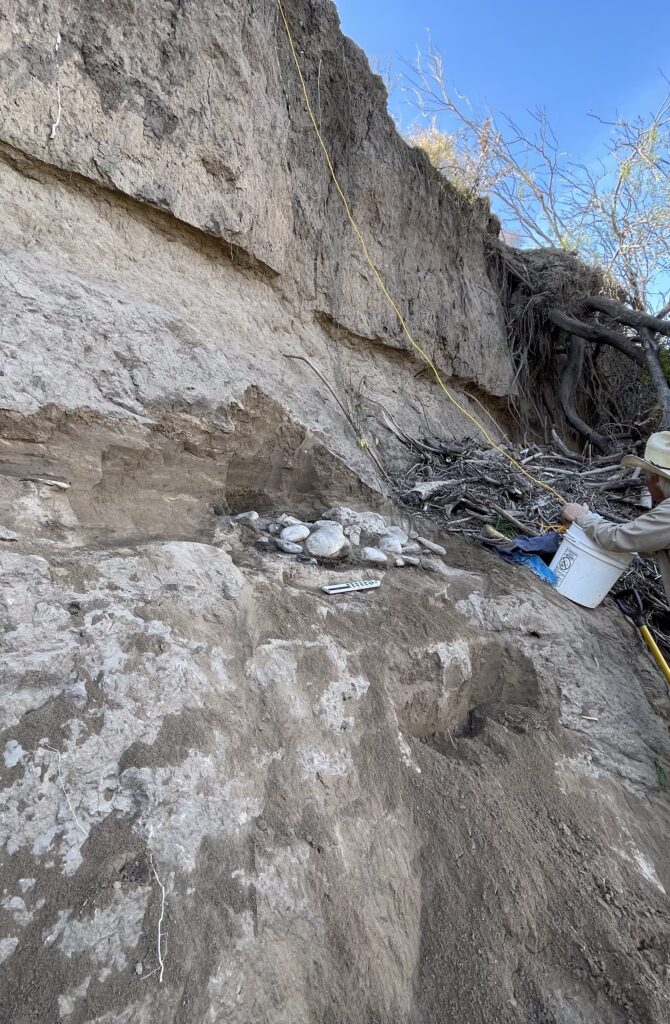
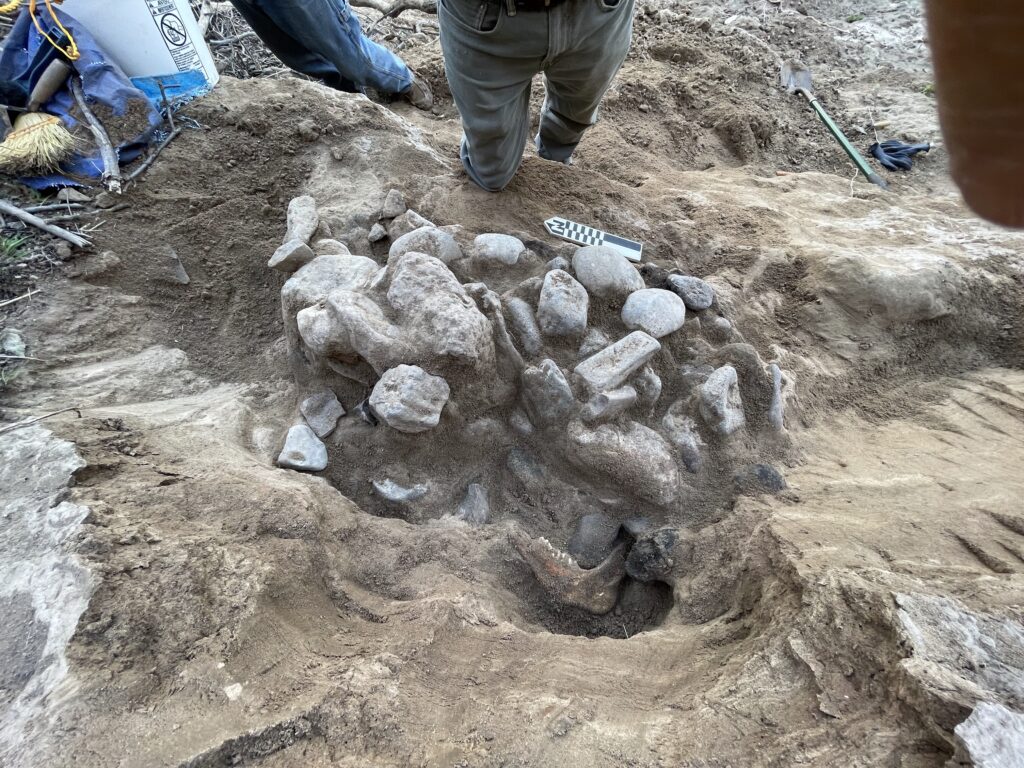
On the last day of excavation in September 2025, a large oven feature was noticed in the cutback 4 meters below the top of the terrace, exposed by the floods two months earlier. Upon inspection, the feature was found to be composed of an oven bed of river cobbles covered with bison bones and underlain by what appeared at the time to be a 5-cm-thick layer of charcoal. This layer turned out to be mostly carbon-stained earth but some tiny pieces of charcoal were still present and later identified as being from a hardwood species and tree bark. LUAS plans to get radiocarbon dates on both the bone and charcoal to see which of the three known periods during the Archaic of bison presence in the Southern Plains this feature belongs. The dates could extend the length of one of these periods or could indicate a completely new and previously unknown period of bison presence in the region.